Showing posts with label Silver Age. Show all posts

Wednesday, 19 June 2013

Munir's Disney Retrospective -- Animated Classic #23: The Rescuers (1977)


Last Week's: Munir's Disney Retrospective -- Animated Classic #22: The Many Adventures of Winnie the Pooh (1977)

The best film of its decade, The Rescuers is also an underrated classic and one which deserves far more attention than it currently receives. Not only is the animation better and more inspired than in previous offerings, but the story packs much more heart and the characters are strongly characterized by a wonderful voice cast (led by Bob Newhart and Eva Gabor) and great character animation from veteran animators like Frank Thomas and Ollie Johnston. This is also the last film the “Nine Old Men” worked on before retirement (they helped a little in the transition with The Fox and the Hound but this was their last full job) and like The Jungle Book was Walt’s swan song, this wonderful little film is the proper goodbye from the studios’ top artists. Not only do you care about these little mice and their quest to rescue a young orphan, but you will also be very entertained by action-packed scenes, humorous moments and touching scenes. The 70s may not have been the brightest decade in the studios’ history, but The Rescuers is certainly one of the brighter spots from this era. Rating: 4.5/5.

Next Week: Animated Classic #24 Review: The Fox and the Hound (1981)

Wednesday, 12 June 2013

Munir's Disney Retrospective -- Animated Classic #22: The Many Adventures of Winnie the Pooh (1977)


Last Week's: Munir's Disney Retrospective -- Animated Classic #21: Robin Hood (1973)

Not really a full-length film, The Many Adventures is one of the most charming and sweet films that has come from the studio. Merging three Pooh shorts (some made during Walt’s lifetime) “Winnie the Pooh and the Honey Tree”, “Winnie the Pooh and the Blustery Day” and “Winnie the Pooh and Tigger Too” into one film (additional animation was added to help the story flow smoothly), the Disney animators created a unique film with wonderful minimalistic animation and endearing stories. Due to the fact that these were shorts, the story feels episodic with Pooh jumping from one adventure to another, but that's hardly a distraction and your enjoyment won’t be tampered. The voices are top-notch and the Sherman Brothers songs only add to the film’s enchantment. The Hundred Acre Wood had never been so magical. Rating: 4.5/5.

Next Week: Animated Classics #23 Review: The Rescuers (1977)

Wednesday, 5 June 2013

Munir's Disney Retrospective -- Animated Classic #21: Robin Hood (1973)


Perhaps the weakest film of the entire decade, Robin Hood nonetheless succeeds thanks to a strong cast of characters and the charm of the film’s hero. Due to economic difficulties, most of the animation in the movie is recycled from previous Disney movies. Little John is a cardboard copy of Baloo (including the voice, provided by Phil Harris), Sir Hiss is a shorter version of Kaa (with the same hypnotic powers) and the dance sequence in the forest is a mixture of Snow White, The Jungle Book and The Aristocats. However, if you can see past that, the movie offers plenty of charm and action to entertain the whole family. The voice cast is superb, especially Peter Ustinov in the role of the villainous Prince John, which is easily the best character in the movie. Robin Hood himself is also a charming lead and Maid Marian is a suitable ‘damsel in distress’. The animation, as most of it is recycled, is one of the most uninspired efforts from the studio, but even that has some unique charm. There are many gags, but the humour is a tad uneven and not nearly as funny as The Aristocats. Robin Hood is not one of the studio’s top offerings, but is charming enough to at least warrant a look. Rating: 3.5/5.

Next Week: The Many Adventures of Winnie the Pooh (1977)

Friday, 31 May 2013

Munir's Disney Retrospective -- Animated Classic #20: The Aristocats (1970)


Make Sure You've Read: Munir's Disney Retrospective -- Silver Age (Part 3) Introduction

The Aristocats was the final film to have Walt’s approval, but he didn't see its development. After the huge success of The Jungle Book in 1967, The Aristocats didn't do as well as its predecessor and, in terms of quality, is also not on par with it. The Aristocats tells the story of Madame Bonfamille, a rich French old lady who wants to leave all her inheritance to her beloved cats: Duchess and her three kittens, Toulouse, Marie and Berlioz. This is not well received by the lady’s faithful butler Edgar, and he plans to get rid of the cats so he can inherit everything. He leaves the cats in the outskirts of Paris and they embark on an adventure to return home, with the help of a stray cat named Thomas O’Malley. The Aristocats is the definition of fun. While the beginning of the film is slow, once the cats are lost, all the adventure begins and it's a very entertaining journey with lots of funny moments and action. The problem with the film is that it lacks some recognizable characters and tends to be forgettable (which is not the case with The Jungle Book). The animation isn't very inspired and lacks some of the grandeur of early productions. What saves the picture though are the excellent and catchy songs by the Sherman Brothers, and the infinite amount of gags in the story (the sequence with the geese is a particular highlight). All in all, The Aristocats may not be a groundbreaking film but it still offers tons of fun and good-hearted entertainment. Rating: 4/5.

Next Week: Animated Classic #21 Review: Robin Hood (1973)

Wednesday, 29 May 2013

Munir's Disney Retrospective -- Silver Age (Part 3) Introduction


Last Week's: Munir's Disney Retrospective -- Animated Classic #19: The Jungle Book (1967)

Silver Age (1950-1977)
The 70s

Overview

With Walt gone, the animation studio entered the 70s filled with uncertainty. The “Nine Old Men” took charge of the studio but it's undeniable that some of the ‘magic’ was lost in this decade. Carried by the motto “What Would Walt Do?" (a motto that was used until the mid-80s when the company made big changes and went for a different direction, the animators played it “safe” and produced animated features that, while fun, didn't break new ground story-wise or technologically speaking. Many refer to this decade as the beginning of the “Dark Age” that was prevalent at the company until the late 80s, but I think that, while the films released in this era can’t (for the most part) surpass their predecessors, they were still made by the same men and women that made all the Walt-era classics and are pretty entertaining and often heartfelt too. For that reason, these films represent the final batch of the classic era that started in the 1930s with Snow White.

Wednesday, 22 May 2013

Munir's Disney Retrospective -- Animated Classic #19: The Jungle Book (1967)


Last Week's: Munir's Disney Retrospective -- Animated Classic #18: The Sword in the Stone (1963)

Walt Disney didn't live to see The Jungle Book in theatres, but his touch on the film is undeniable. Dissatisfied with the studio's two previous efforts, Walt turned his full attention to this film - something he hadn't done since the 50s - and turned the initially dark story into a lively and colourful tale. Instead of being faithful to the grim Rudyard Kipling novel, Walt and his team just took some basic characters and altered the storyline into something more fun-filled, with memorable characters and catchy music. While the plot may be light, we aren't so much interested in the ultimate goal as on the journey that the characters take - and what a fun journey it is! The Jungle Book was Walt's swan song and it's a testament to his vision as a storyteller and filmmaker that it remains one of the studio's most treasured classics. Rating: 5/5.

Next Week: Animated Classic #20: The Aristocats (1970)

Saturday, 18 May 2013

The Sword in the Stone and Robin Hood Coming to Blu-ray on 6th August


After recently announcing The Little Mermaid, Oliver and Company and The Many Adventures of Winnie the Pooh, Disney still isn't done releasing their catalogue titles just yet. They have recently announced the release of two more films: The Sword in the Stone (1963) and Robin Hood (1973).

Wednesday, 15 May 2013

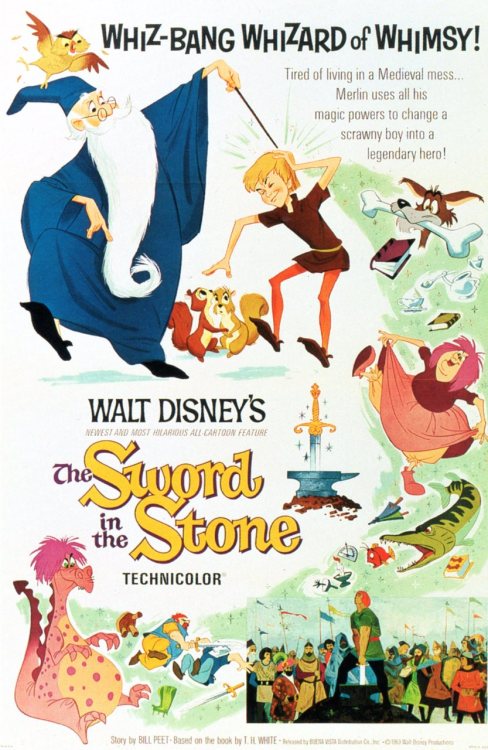
Munir's Disney Retrospective -- Animated Classic #18: The Sword in the Stone (1963)


Last Week's: Munir's Disney Retrospective -- Animated Classic #17: One Hundred and One Dalmatians (1961)

The Sword in the Stone was the last film Walt was alive to see, and is also his weakest (not counting the anthology films). The story of King Arthur's beginnings is retooled here as series of lessons to the future king, and while many moments are amusing and charming, the pacing is  sometimes uneven, making the film a little bit slower than expected. The animation lacks the grandeur of past films but the character animation is excellent. And, while the protagonist is not very interesting, the supporting players (mainly Merlin, Archimedes and Madame Mim) are a delight from beginning to end and help elevate the picture from its uneven rhythm. Plus, the epic battle between Merlin and Madame Mim is one of the most memorable and beautifully animated sequences in all of animated film. All in all, The Sword in the Stone may not be an instant Disney classic but has enough charm and magic to delight young and old audiences. Rating: 4/5.

Next Week: Animated Classic #19: The Jungle Book (1967)

Friday, 10 May 2013

Munir's Disney Retrospective -- Animated Classic #17: One Hundred and One Dalmatians (1961)


Make Sure You've Read: Munir's Disney Retrospective -- Silver Age (Part 2) Introduction

The first film to use the Xerox technique, 101 Dalmatians was reportedly very much liked by Walt. With his mind on other projects like his TV show and his magnum opus, Mary Poppins, most of the burden went to story artist Bill Peet and 101 Dalmatians truly is one of Disney's best films and a real classic. The story of two dogs rescuing their puppies from a mad woman was a departure from the fairy tale lands that graced past Disney productions. By setting the movie in real time, 101 has a fresh tone that hasn't diminished with time. It's full of action, gags and the character animation is simply amazing. Cruella De Vill is one of the greatest villains created for an animated film and one of the most memorable characters ever committed to film. Add two very likeable leads and 99 adorable puppies and you have a charming an endearing Disney classic. Rating: 5/5.

Next Week: Animated Classic #18 Review: The Sword in the Stone (1963)

Wednesday, 8 May 2013

Munir's Disney Retrospective -- Silver Age (Part 2) Introduction


Silver Age (1950-1977)
The 60s


Overview

After a very productive decade, Walt entered the 60s as a very established personality. Disneyland was fully operational and plans for Walt Disney World had started, he was a TV personality, and the five films released in the 50s were mostly well-regarded and turned out profits (except for Sleeping Beauty which was the most expensive film Walt ever made). But because Sleeping Beauty failed to recoup its monumental budget, the studio was in financial trouble yet again and, in order to keep it afloat, the animation department developed a new technique called Xerography were the animation sheets were processed and coloured automatically without the aid of the ink & paint department. While this technique made the animator's work more visible, this also meant that the ink & paint department closed, laying off many people and concluding a beautiful animation era. Nonetheless, the three films that were released in this decade are full of charm and at least two of them are regarded as classics nowadays. These three films were the last ones that had Walt’s touch before his unfortunate death in 1966.


Tomorrow: Animated Classic #17 Review: One Hundred and One Dalmatians (1961)

Wednesday, 1 May 2013

Munir's Disney Retrospective -- Animated Classic #16: Sleeping Beauty (1959)


Arguably the most ambitious film Walt created in his entire career, Sleeping Beauty is truly a sight to behold. Spending the entire 1950s in development, innovating new techniques (Super Technirama) and pushing the envelope in every aspect of its production, the film ended being the most expensive endeavour in Walt’s career. It nearly bankrupted the studio when it premiered, and it signalled the end of the ink & paint era for the studio (they would instead go on to use the newly created Xerox technology, a less expensive tool, in future films), but Walt had truly created a unique movie. From its lavish and opulent backgrounds to its spectacularly designed characters, the film’s ambitiousness is limitless. The gorgeous animation and the breathtaking colours envelop the viewer throughout the movie and never let go. Also, accompanying the perfect technical achievement is a wonderful fairy tale full of magic, romance, evil and a wondrous Tchaikovsky score that holds everything together. The unforgettable characters make an impression on you and even if many have criticized the title heroine as ‘passive’, I think it serves the story right and advances the plot in a wonderful way. No film, before or after, has matched the sheer marvelousness of this one. Rating: 5/5.

Next Week: Animated Classic #17 Review: One Hundred and One Dalmatians (1961)